
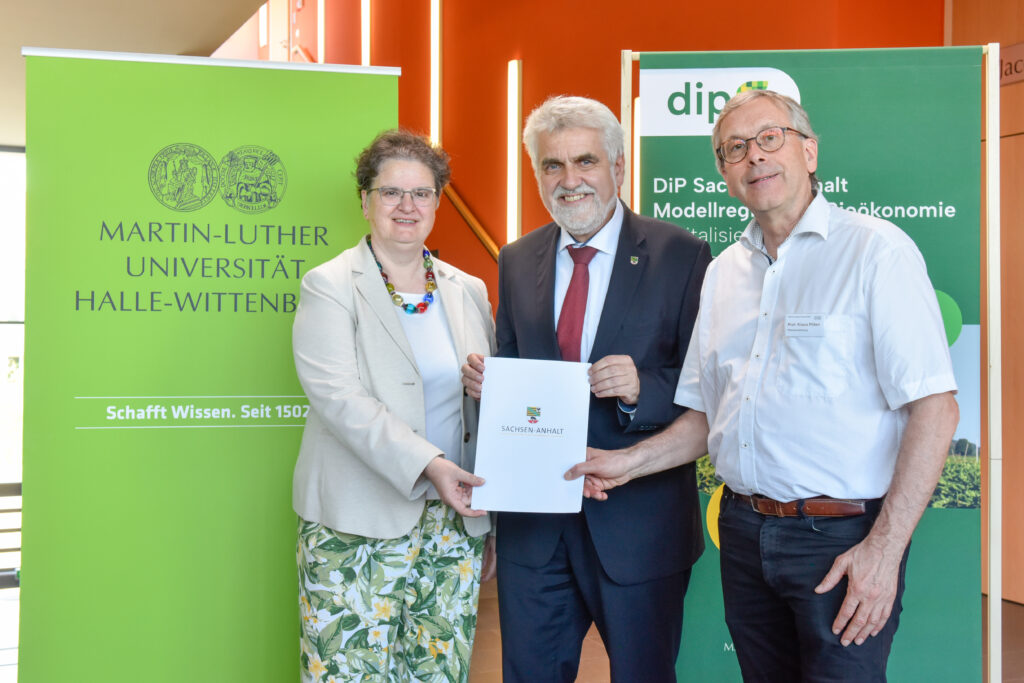
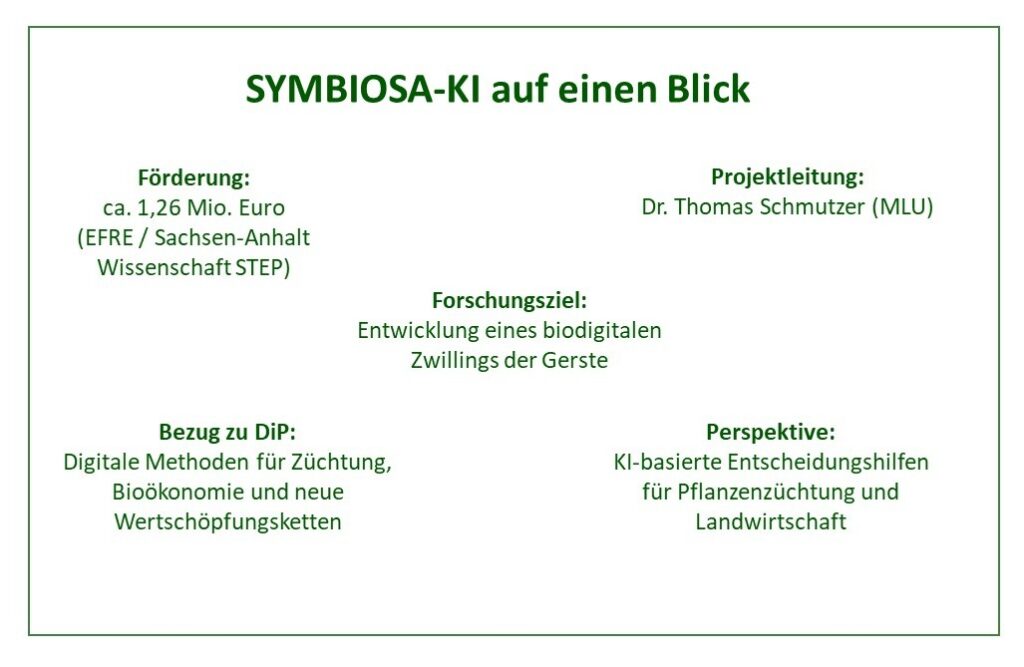
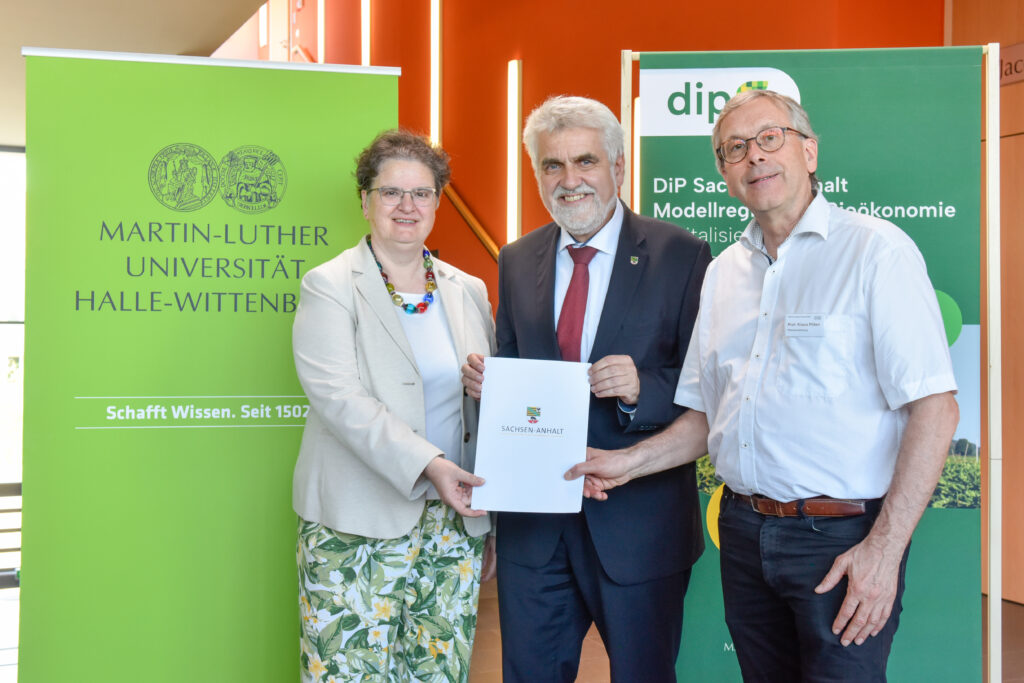
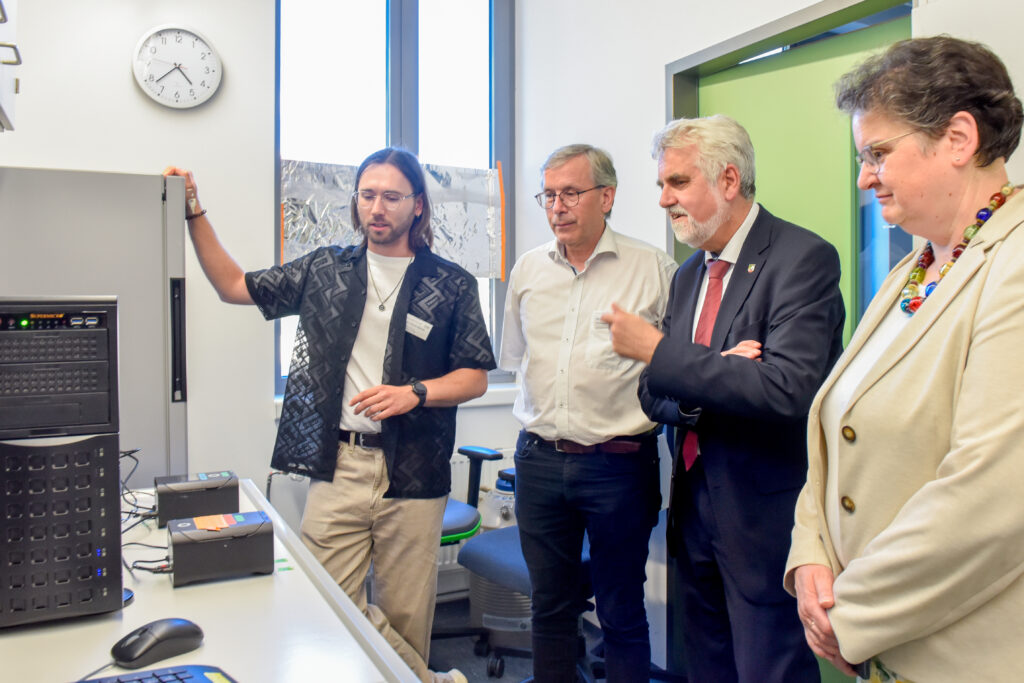
The digitalisation of the bioeconomy in Saxony-Anhalt is receiving further tailwind: The “SYMBIOSA-KI” research project at Martin Luther University Halle-Wittenberg is being funded with around 1.26 million euros from ERDF funds as part of the “Saxony-Anhalt Science STEP” programme. The funding notification was presented on 16 July 2026 by Minister of Science Prof. Dr. Armin Willingmann as part of his summer tour.
For the DiP network, the funding is much more than a new individual project: SYMBIOSA-KI complements central research approaches of DiP and strengthens the scientific basis for the development of new plant value chains.
A biodigital twin for plant research
The project focuses on the development of a biodigital twin of barley. The aim is to digitally map the growth and development of the crop as realistically as possible with the help of artificial intelligence. To this end, genetic information, environmental conditions, plant growth and data on soil and microbiome over the entire life cycle of the plant are brought together and modelled.
On this basis, new possibilities are to be created to better predict plant reactions and to develop breeding strategies in a more targeted manner. In the long term, this could result in an AI-supported assistant that supports plant breeders or farms, for example, in making decisions.
Ideal addition to the DiP network
The new funding is directly linked to the work of the DiP Saxony-Anhalt research network. While DiP is developing new value chains based on plants and plant side streams, SYMBIOSA-KI will provide additional digital tools in the future to better understand plants and accelerate innovations along the entire value chain.
MLU Rector Prof. Dr. Claudia Becker emphasised at the presentation of the funding notice: “The new STEP funding is the ideal complement to the work of the DiP Saxony-Anhalt network, within the framework of which we are working on new value chains for the bioeconomy in southern Saxony-Anhalt. The knowledge gained from the project will help to develop new breeding and application strategies.”
DiP spokesperson Prof. Dr. Klaus Pillen, who accepted the funding decision on behalf of project manager Dr. Thomas Schmutzer (DiP-DIAMANT), also sees great potential: “With SYMBIOSA-AI, we want to decisively advance digitization in the plant sector and thus create new value chains and further develop existing ones.”
Digitalisation as the key to the bioeconomy
The funding underlines the particular strength of Saxony-Anhalt as a research location: Here, internationally visible plant research, modern data science and artificial intelligence meet efficient agriculture and a traditional chemical industry.
This is exactly where DiP comes in. The aim of the network is to make digital technologies usable for a sustainable, resource-efficient and competitive bioeconomy – from climate-adapted crops to new bio-based products and regional value chains.
With SYMBIOSA-KI , this innovation ecosystem now has another important building block. In the future, the methods developed in the project can help to accelerate research processes, better predict new plant traits and translate innovations into practical applications more quickly. In this way, the project not only strengthens top-level research in Saxony-Anhalt, but also the long-term goals of the DiP network to actively shape structural change in the Central German mining area.
More information at campus halensis