
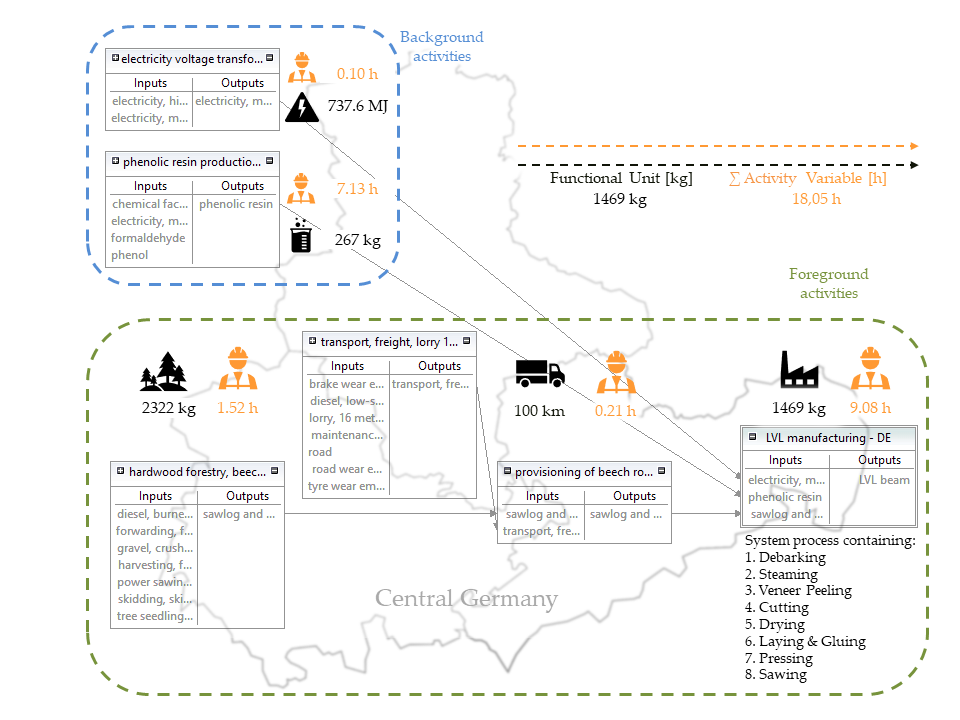
The team of the DiP accompanying research at the UFZ provides the first available method that combines ecological, economic and social impacts of production and consumption systems in a single assessment framework – and which is also open to the DiP projects.
How sustainable is a new bio-based material compared to its predecessor, which is based on fossil raw materials? Does a digitized cultivation process actually save resources or does it just shift the burden to another point in the value chain? And what does this mean for jobs, income and working conditions in the region? Until now, such questions have usually been answered separately: environmental impacts via a life cycle assessment, costs via life cycle cost calculation, social effects via yet other processes. The results are then displayed side by side, but not in relation to each other. This is exactly where HILCSA comes in.
Three dimensions, one evaluation framework
HILCSA (Holistic and Integrated Life Cycle Sustainability Assessment) was developed by Dr.-Ing. Walther Zeug and his team at the Helmholtz Centre for Environmental Research (UFZ) – at the Department of Systems Analysis and Sustainability Assessment (SANA) headed by Prof. Dr.-Ing. Daniela Thrän, who also coordinates the accompanying DiP research. After years of further development, numerous case studies and intensive technical discussions, the method is now the first of its kind to be available for licensing.
HILCSA considers processes, products, organizations and entire regions as interconnected systems – material and energy flows as well as working and social conditions. Around 80 indicators are condensed into understandable indices and key figures; 14 of the 17 UN Sustainable Development Goals (SDGs) are covered. This makes visible not only individual measured values, but also the connections between them: conflicting goals, synergies and hotspots, and whether an improvement in one place is bought with a deterioration in another.
Technically, the method has been implemented in the open-source software openLCA and draws on established databases such as ecoinvent and soca. The consolidated version 2.3, including documentation and application instructions, is provided via the openLCA platform Nexus.
Why this is relevant for DiP
For the DiP network, HILCSA is more than just technical news: the method is the central tool with which the accompanying research at the UFZ assesses the sustainability of DiP innovations – from the crop to the processing to the finished product. It is already being used in the DiP-LeFOS project (Lighthouse 1). In addition, there are regional case studies on building materials, nutrition and biorefineries in Saxony-Anhalt. For the DiP projects, this means that sustainability assessment is not a downstream compulsory exercise, but an instrument that provides indications during development of where an innovation has its strengths and where adjustments should be made.
Subject-specific classification
The publication is also a milestone beyond DiP. Fifteen years after Jeroen Guinée’s review “Life Cycle Assessment: Past, Present, and Future” (2011), HILCSA is the first mature, integrated LCSA method for impact assessment (LCIA) that goes beyond the additive juxtaposition of E-LCA, S-LCA and LCC. This makes LCSA more practical, transparent and better usable for decisions in real sustainability transformations, including possible points of contact with the Digital Product Passport (DPP) and the EU Ecodesign Regulation ESPR. Accordingly, the method is relevant not only for research, but also for politics, industry and civil society.
Walther Zeug sums up the new standard to be achieved with the new tool as follows: “Sustainability cannot be evaluated in separate drawers. With HILCSA, we can finally look at ecological, economic and social effects in an integrated framework – and that is exactly what we need in order to accompany transformation processes like the one in Saxony-Anhalt in a scientifically sound way.”
Contact us
Dr.-Ing. Walther Zeug
Phone: +49 341 60 25 4771
E-mail: walther.zeug@ufz.de
Briefly explained:
Life Cycle Assessment (LCA): Process that records the environmental impact of a product over its entire life cycle – from raw material to production and use to disposal.
LCSA: Expansion of the life cycle assessment to include economic and social aspects (“Life Cycle Sustainability Assessment”).
LCIA: The step in which measured material and energy flows are translated into effects – for example, into contributions to climate change. HILCSA is such an impact assessment method.
openLCA / Nexus: Freely available software for life cycle assessments and the associated platform through which databases and methods are obtained.
ecoinvent & soca: Databases with environmental and social data on thousands of production processes worldwide.
Hotspot / Conflicting Goals: A hotspot is the point in the life cycle with the greatest impact. A trade-off occurs when an improvement – such as less CO₂ – results in a deterioration elsewhere.
Further links:
HILCSA at the UFZ: https://www.ufz.de/index.php?de=50083
Method on openLCA Nexus: https://nexus.openlca.org/database/HILCSA
Announcing openLCA: https://www.openlca.org/hilcsa-method-is-now-available-on-nexus/
DiP Project LeFOS (Lighthouse 1): https://www.dip-sachsen-anhalt.de/projekt/dip-lefos/
DiP accompanying research (BegleitDiP) at the UFZ: https://www.ufz.de/index.php?de=52025