
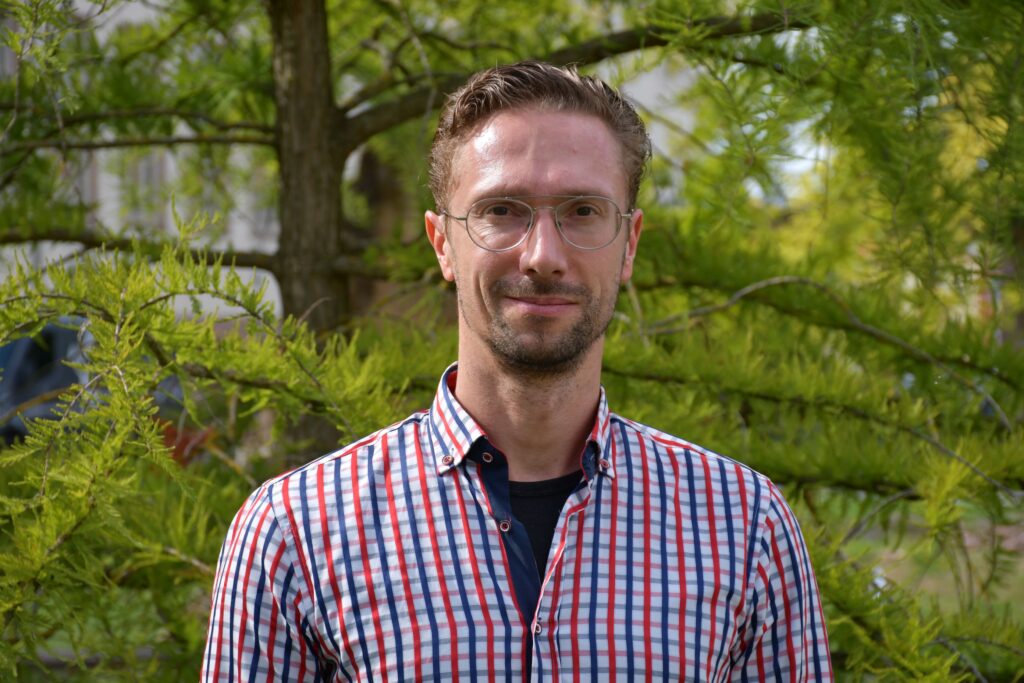
Dr. Thomas Schmutzer on the potential of digital models for plant breeding
Crossbreeding, field trials, and ratings have proven their worth, but they don’t show everything. In an interview, Dr. Thomas Schmutzer explains why the root microbiome remains a blind spot in breeding, even though it influences how well a plant absorbs nutrients and survives dry phases, and how a biodigital twin helps barley to breed it for the dry year 2040. In the full interview, you can read why the real field still decides in the end, why the biggest bottleneck is not in the laboratory – and what that means for Saxony-Anhalt.
DiP: Dr. Schmutzer, you are working with DiP-DIAMANT on digital precision genomics and are now developing a biodigital twin for barley with SYMBIOSA-AI. What can digitization achieve in plant research that would hardly be possible with classical methods alone?
Thomas Schmutzer: “The classic methods are established and retain their full justification – crossbreeding, field trials and ratings depict what a plant actually does under real conditions. I don’t want to pretend that digitization is new in breeding: genomic selection and favorable genotyping have been standard for years. However, a marker model only ever sees one level, namely the relationship between genotype and trait. A significant part of what determines a plant’s performance does not appear in it at all. The root microbiome is such a blind spot: it influences how well a plant absorbs nutrients and survives dry phases – and is not found in any common selection model. This is exactly where we come in with SYMBIOSA-KI: We bundle the existing resources of the barley – genome, gene activity, soil, weather and microbiome – over the entire life cycle in one model. The benefit is not in another individual measurement, but in the link.”
From the digital analysis of the genome to the biodigital twin: How do such technologies change plant breeding in concrete terms and what could this mean for agriculture and the bioeconomy in Saxony-Anhalt in the long term?
“This is most evident where classical forecasting reaches its limits. Genomic selection is strong within its experiential space, but it extrapolates poorly in environments for which there is no training data. And that’s exactly what we need: no one breeds for the mean value, but for the dry year 2040 on a specific site. A biodigital twin allows such scenarios to be played out on the computer. Secondly, it models the course and not just the end result. Two varieties can achieve the same yield in completely different ways – early tilling or late compensating. If the growing seasons shift, the path is decisive. What is important to me is that biodigital twins appear in the background in their application. In the end, what counts is the performance of the real plant in the real field. The twin does not replace the field experiment or genomic selection, it encloses them – and we have yet to prove that it predicts better in unseen environments. The target image is an assistance system: variety selection for the farmer, crossing strategy for the breeder. For Saxony-Anhalt, this means more robust, resource-efficient varieties and added value that remains in the region, from data analysis to the product.”
DiP pursues the goal of using digitalisation along the entire plant value chain. Where do you see the most exciting next steps and what role can Saxony-Anhalt play in this?
“The most exciting and at the same time most challenging step is the consistency of the data chain: connecting genome data, sensor technology in the field and process data from processing in such a way that they explain each other. The bottleneck has long since ceased to be the individual process, but standards, formats and interoperability – unspectacular, but crucial. The second bottleneck is people. We need smart minds who understand plant science and data analysis in equal measure, and they are not trained in a year. DiP as a whole is therefore always a place of training – a collective for the transfer of expertise and knowledge. Saxony-Anhalt has a starting point that other regions do not have. The SYMBIOSA-KI as a project of the state’s new STEP funding docks directly to the federal project DiP is a good example. It shows that federal and state funding are intertwined instead of running side by side. Such impulses, but above all what is visible at the joint meetings, make me confident: a model region is indeed being created here.”
Project link DiP-DIAMANT
Publications in the project can be found here.