
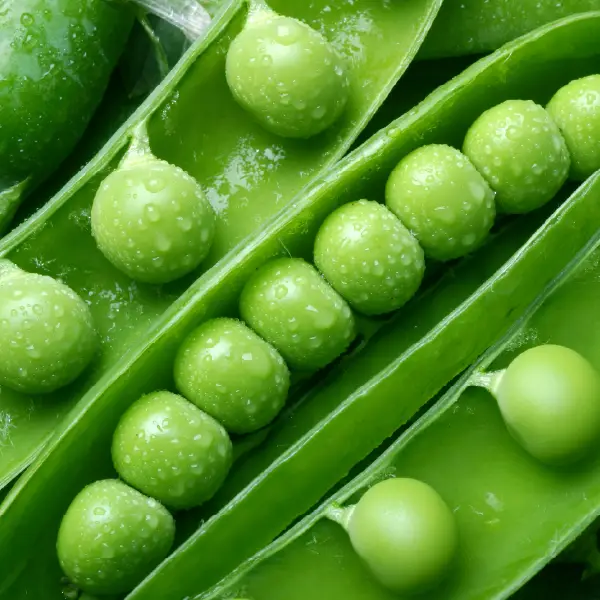
The pea is an example of the challenges of sustainable agriculture: ecologically sensible, agronomically interesting, but economically not a sure-fire success. The example of pea cultivation shows how the project “Digitalisation of Plant Value Chains” (DiP) can generate new value creation potential by means of efficient optimisation of cultivation, breeding, processing and process digitalisation and thus provide impetus for successful structural change in Saxony-Anhalt.
Professor Annette Deubel heads the cultivation research work package in the DiP-DiPisum project of the DiP network. She sees a lot of potential in the systemic approach of the project: “We cover the entire value chain in agriculture. We are working towards developing innovative new products with sustainable future potential from agriculturally available products, and further promoting and establishing high-quality processing here in the state.” The example of pea cultivation is a good example of this: “The pea has considerable ecological advantages and has the potential to become a sustainable source of protein in the future. As a legume, it can fix nitrogen from the air and thus reduces the need for mineral fertiliser, which is a plus for the CO₂ balance. At the same time, however, its cultivation is challenging,” says Deubel, “because it places high demands on crop rotation and cultivation breaks, for example.” Stable yields require a lot of experience and adapted procedures.
Digitization as an efficiency driver
“This is where digitization comes into play,” says the professor, who teaches crop production and plant production at Anhalt University of Applied Sciences. “In breeding, digital methods help, for example, to screen large genetic resources specifically for desired traits, such as taste characteristics, protein composition or resistance. The Leibniz Institute of Plant Genetics and Crop Plant Research (IPK) Gatersleben is an important partner for us as a project coordinator.” In plant production, drone overflights and sensor procedures enable a systematic population analysis – a competence that in turn can contribute to the research work of Anhalt University of Applied Sciences. Stress, diseases or pest infestation could thus be detected at an early stage in order to react in a targeted manner. At the same time, variants can be precisely compared in testing and cultivation methods can be optimised. Fertilisation and crop protection can also be carried out in a more targeted and precise way, explains Deubel. Digitalisation is thus becoming an efficiency factor in cultivation and the basis for stable, defined raw material qualities.
Quality must be reproducible
After all, the decisive hurdle is often not in the field, but in the market. The professor describes the problem vividly: “A very good vegan yoghurt can be made with one batch, but suddenly it doesn’t work with the next batch.” This is because pea proteins have not yet been available in a sufficiently standardised form. This is also where the research expertise of the DiP network comes in: How can the corresponding processes be optimized, the products standardized, and processing rails further developed?
Anne-Karen Beck, who is responsible for the transfer of knowledge from research to practice in the DiP project, formulates the claim clearly: the decisive sticking point is the transfer between science and industry. “Market issues are taken into account in all joint projects from the very beginning: Who is the market? What prices are realistic? Which partners are still missing?” In this way, the research results should create the necessary, practical economic perspective for the region.
Regional strength paves the way for structural change
Saxony-Anhalt in particular offers favourable conditions for this. Deubel refers to a “unique concentration of research expertise” as well as to “large operating structures that can facilitate investments in innovation and provide relevant product quantities for processing”. Large farms are also more likely to be able to integrate new crops and develop further mainstays. From sustainable cultivation to digitally supported quality control to the regional processing of high-quality products, the example of the pea shows what successful structural change in agriculture can look like in concrete terms. If the dovetailing is successful, new processing steps, new business models and, in the future, new jobs will be created. DiP sees itself not only as a research association, but also as a bridge between agricultural practice, industrial processing and economic transformation.
This post is based on episode 9 of the podcast “Talking Plants” by Farmerspace, the experimental field for digital agriculture. The project was funded by the BMLEH and supported by the BLE (FKZ 28DE104A18). For the website, the conversation was editorially shortened and prepared in text form. You can listen to the full podcast episode here .