
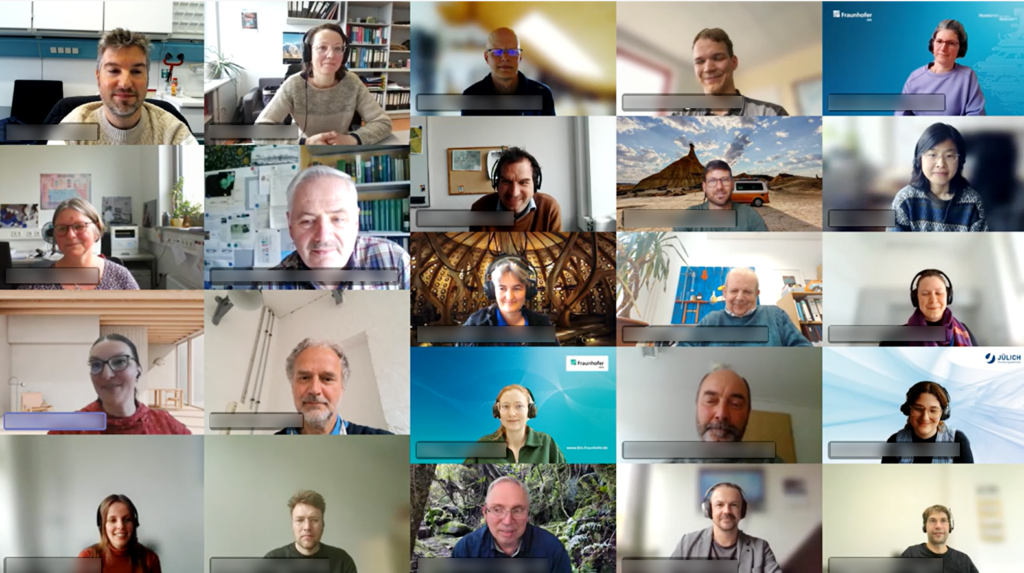
Two areas undergoing structural change, one topic: How does the bioeconomy contribute to the transformation of regions as a driving force? On Monday, 13.4., the kick-off of our joint online series “Districts in Dialogue – DiP meets BioeconomyREVIER” took place. This time the focus is on special crops in structural change. In addition to exciting impulses from the economy on the potential and challenges of special crops (Fred Eickmeyer, ESKUSA GmbH and Martin Junghanns, Dr. Junghanns GmbH), six research projects from the regions introduced themselves to each other and discussed their respective approaches.
One finding was that special crops combine high value-added potential with high default risks. Therefore, what is needed above all is competence, good harvest timing and available manpower. Another advantage is a holistic approach that both companies pursue as breeders, growers, processors and producers of end products.
The exploitation of this potential requires a local and regional expansion of the value chains – then plant-based active ingredients from special crops, such as herbal and medicinal plants or, for example, from fruit residues can develop considerable economic potential. The background to this is that a significant part of the added value is generated in the extraction of high-quality active ingredients. Together with the resulting end products in pharmaceuticals, health, food additives and cosmetics, as well as the consequent local supply chain, an innovative and competitive field of the future is emerging.
Both regions benefit from the existing research expertise, which provides constant impetus for the further development of varieties and processing methods, for the identification and enrichment of active ingredients and for the scaling of processes. This was represented by four projects from the DiP network: DiP-NA-WIR, DiP-OptiLamia, DiP-Tres2Cera and DiP-HyperSpace, and two projects from the BioeconomyREVIER innovation cluster with Circular PhytoREVIER and the AgroInnovationLabs.
After the kick-off, the participants agreed that the format should be continued and that networking should be intensified with new common topics. Mutual learning and the exchange of approaches can advance both regions and bring them even further into focus as model regions. Topics of the next issues could come from digitization and robotics, among other things.