
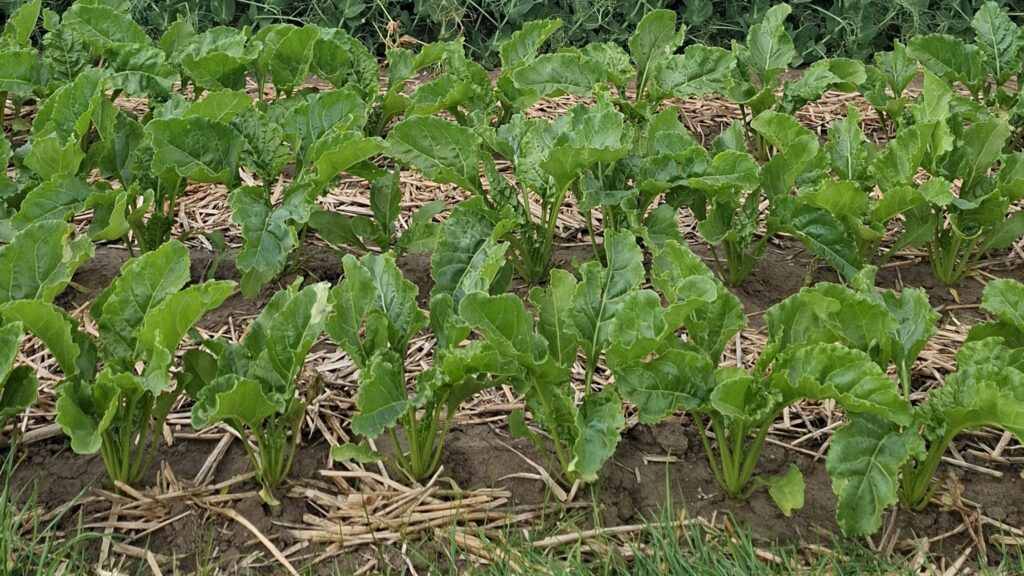
How sustainable and economical is strip tillage in sugar beet cultivation? This question will be addressed by the joint project DiP-ZAZIkI at the first SugarBeet Expo on 9 and 10 September 2026. With the lecture “Strip tillage in the dry region of southern Saxony-Anhalt: First results on sustainability and profitability from on-farm trials”, the project presented current results from practical trials on 10 September in the open-air area.
The international open-air trade fair, which is taking place for the first time, combines practice, technology, digitalisation and sustainability in professional sugar beet cultivation. It thus offers a suitable framework for discussing research results with agricultural practice, research and industry.
Sugar beet cultivation under new conditions
Drought, erosion and extreme weather events pose challenges for sugar beet cultivation. How can cultivation systems deal with this better and at the same time remain economical and resource-conserving? DiP-ZAZIkI investigates this question on practice areas in Saxony-Anhalt.
Digitalisation is not an end in itself. The decisive factor is what can be derived from the data collected for practical purposes. The focus is on the question of how data can be used for better cultivation decisions. To this end, the project combines drone and satellite monitoring as well as artificial intelligence (AI) with field trials and experience from agricultural practice.
Strip-Till: Targeted cultivation of the soil
In strip till tilling, only the area where the sugar beets will later be sown is loosened. Between the rows, the soil remains untilled and protected by plant residues. This can reduce evaporation, protect the soil structure and limit erosion. In combination with under-root fertilisation and sowing in a single pass, fuel and fertiliser can also be saved.
Since 2025, the process has been compared with practical soil cultivation on practical farms in Hinsdorf and Pretzsch. Among other things, plant development, soil moisture, nitrogen reserves, yield and greenhouse gas emissions are examined.
First results
The results so far show a higher soil water availability in the strip-till variants. In contrast, no clear differences could be found in the yield. The results underline the importance of multi-year trials, as the effect of a cultivation system depends on location, weather and management.
Collecting, evaluating and putting data into practice
Drones provide high-resolution information about plant populations and test areas. This data is combined with satellite images and measurements of soil moisture, nitrogen and plant development. This creates a more comprehensive picture of how the plants react to different cultivation conditions. Within the framework of drone network meetings, researchers and practice partners also regularly exchange ideas about new applications and methods of data collection and evaluation. Drone and satellite data are therefore linked to measurements of soil moisture, nitrogen and plant development. AI is intended to help evaluate large amounts of data and identify correlations. In the long term, this should result in digital decision-making aids for site-adapted sugar beet cultivation.
Research directly in the field
How research and practice interact was also visible in March 2026 during two field inspections on the occasion of sowing. In Saxony-Anhalt, the strip-till process and the technology used were demonstrated and initial project experiences were discussed. At the Reupzig site, the field inspection was organised by the Institute for Sugar Beet Research together with Pfeifer & Langen.
Data-driven cultivation systems are not only created in the laboratory or on the computer. They have to prove themselves under real conditions and be further developed together with the people who will later use them. DiP-ZAZIkI therefore combines digital technologies with on-farm research and agricultural practice. The project is now bringing the first results on strip soil cultivation to the SugarBeet Expo in the exchange about the future of sugar beet cultivation.
Project link DiP-ZAZIkI
Publications in the project can be found here.