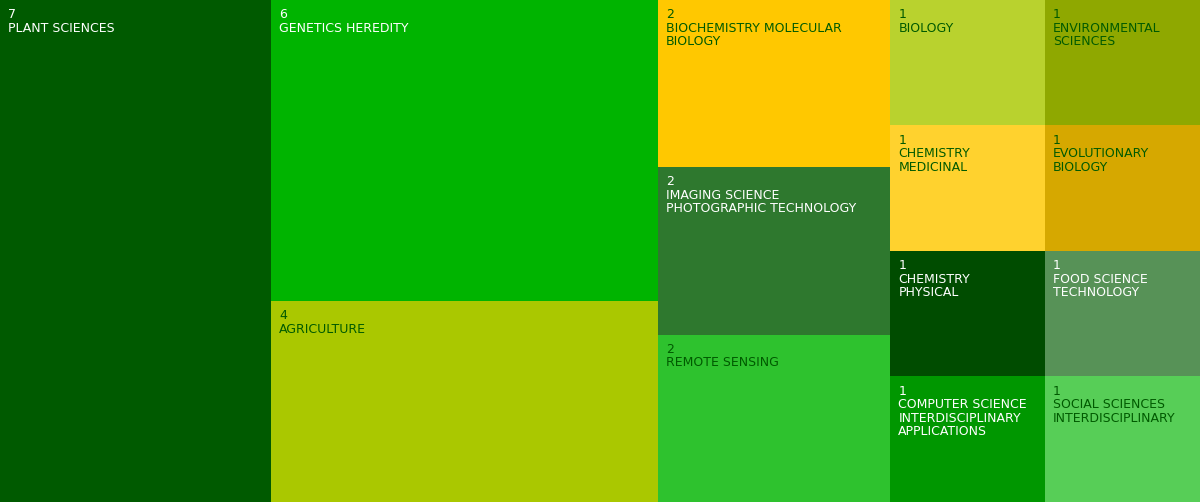
Soleimani, Sahel; Wichmann, Philip; Pillen, Klaus; Neumann, Kerstin; Maurer, Andreas Tillering plasticity of drought-stressed barley genotypes under different re-watering regimes Journal Article In: BMC PLANT BIOLOGY, vol. 25, no. 1, 2025, ISSN: 1471-2229. @article{WOS:001593332300001,
title = {Tillering plasticity of drought-stressed barley genotypes under different re-watering regimes},
author = {Sahel Soleimani and Philip Wichmann and Klaus Pillen and Kerstin Neumann and Andreas Maurer},
doi = {10.1186/s12870-025-07504-8},
issn = {1471-2229},
year = {2025},
date = {2025-10-01},
urldate = {2025-10-01},
journal = {BMC PLANT BIOLOGY},
volume = {25},
number = {1},
abstract = {Background One future challenge of agriculture will be maintaining food
security in times of climate change. Future plant breeding, therefore,
has to account for the genotypes\' survival during drought and a good
recovery ability after rainfall events. We aimed at investigating the
re-tillering behavior of selected barley genotypes (cultivars and wild
barley introgression lines) in different drought and re-watering
scenarios, which were applied in a high-throughput phenotyping facility.
Re-tillering describes the activation of additional tillers after
post-stress irrigation. Results Twenty-three selected genotypes of the
barley NAM population HEB-25, along with three control genotypes, were
evaluated in four replicates under five distinct treatment conditions.
In this experiment, re-tillering was particularly pronounced in an
alternating watering and stress treatment, where the resumption of
irrigation post-stress enabled full recovery of the plants. However, it
was noted that while re-watering after a stress period promotes tiller
activation and the development of fertile ears, it also tends to
increase the number of sterile ears. The degree of sterile ear formation
varied significantly among different genotypes, highlighting the
critical role of genetic factors in modulating plant responses to
re-tillering and post-stress irrigation. It is important to note that
excessive re-tillering has been shown to exhibit a negative correlation
with fertile ear weight. Conclusions The impact of focusing on tiller
number and re-tillering behavior in future barley breeding may be
significant, particularly in the context of climate change. By selecting
for genotypes with appropriate tillering plasticity, breeders can
develop barley varieties that are more resilient to stress conditions
such as drought.},
keywords = {Drought tolerance, Genotype, Plant Breeding, Quantitative trait},
pubstate = {published},
tppubtype = {article}
}
Background One future challenge of agriculture will be maintaining food
security in times of climate change. Future plant breeding, therefore,
has to account for the genotypes' survival during drought and a good
recovery ability after rainfall events. We aimed at investigating the
re-tillering behavior of selected barley genotypes (cultivars and wild
barley introgression lines) in different drought and re-watering
scenarios, which were applied in a high-throughput phenotyping facility.
Re-tillering describes the activation of additional tillers after
post-stress irrigation. Results Twenty-three selected genotypes of the
barley NAM population HEB-25, along with three control genotypes, were
evaluated in four replicates under five distinct treatment conditions.
In this experiment, re-tillering was particularly pronounced in an
alternating watering and stress treatment, where the resumption of
irrigation post-stress enabled full recovery of the plants. However, it
was noted that while re-watering after a stress period promotes tiller
activation and the development of fertile ears, it also tends to
increase the number of sterile ears. The degree of sterile ear formation
varied significantly among different genotypes, highlighting the
critical role of genetic factors in modulating plant responses to
re-tillering and post-stress irrigation. It is important to note that
excessive re-tillering has been shown to exhibit a negative correlation
with fertile ear weight. Conclusions The impact of focusing on tiller
number and re-tillering behavior in future barley breeding may be
significant, particularly in the context of climate change. By selecting
for genotypes with appropriate tillering plasticity, breeders can
develop barley varieties that are more resilient to stress conditions
such as drought. |
Niels, Lanique; Reif, Jochen Christoph; Otto, Lars-Gernot; Mirdita, Vilson; Oppermann, Markus; Lohwasser, Ulrike; Kotter, Matthias; Weise, Stephan; Hanafi, Samira El Harnessing historical genebank data to accelerate pea breeding Journal Article In: Theoretical and Applied Genetics, vol. 138, no. 10, pp. 243, 2025, ISSN: 0040-5752, 1432-2242. @article{niels2025harnessing,
title = {Harnessing historical genebank data to accelerate pea breeding},
author = {Lanique Niels and Jochen Christoph Reif and Lars-Gernot Otto and Vilson Mirdita and Markus Oppermann and Ulrike Lohwasser and Matthias Kotter and Stephan Weise and Samira El Hanafi},
doi = {10.1007/s00122-025-05032-5},
issn = {0040-5752, 1432-2242},
year = {2025},
date = {2025-09-09},
urldate = {2025-09-09},
journal = {Theoretical and Applied Genetics},
volume = {138},
number = {10},
pages = {243},
abstract = {The German Federal Ex Situ Genebank for Agricultural and Horticultural Crops (IPK) harbours over 3000 pea plant genetic resources (PGRs), backed up by corresponding information across 16 key agronomic and economical traits. The unbalanced structure and inconsistent format of this historical data has precluded effective leverage of genebank accessions, despite the opportunities contained in its genetic diversity. Therefore, a three-step statistical approach founded in linear mixed models was implemented to enable a rigorous and targeted data curation. Spring accessions revealed considerable breeding potential, with protein content exceeding market standards by almost one-fifth and with hundred grain weight that could match the upper limits reported for European elite varieties. This variation is embedded within structured populations, comprising five convarieties including sugar snaps and field pea, adding value for breeding across diverse morphotypes and market segments. Winter accessions demonstrated cold resilience, with post-winter survival rate up to 79.27% under minimum temperatures as low as − 17.1 °C. This variation is of particular relevance given the limited availability of winter-hardy cultivars able to evade summer drought and heat stresses. Transformation of the IPK Genebank into a bio-digital resource redirects formerly static material into central leverage for plant breeding in view of contemporary challenges. As such, this investigation activated the IPK pea population for use in among others breeding for a wide variety of ideotypes, research into adaptation, and future combination with omics studies.},
keywords = {Agriculture, Breeding program, Cultivar, DiP-DiPisum, Germplasm, Leverage (statistics), Plant Breeding, Population},
pubstate = {published},
tppubtype = {article}
}
The German Federal Ex Situ Genebank for Agricultural and Horticultural Crops (IPK) harbours over 3000 pea plant genetic resources (PGRs), backed up by corresponding information across 16 key agronomic and economical traits. The unbalanced structure and inconsistent format of this historical data has precluded effective leverage of genebank accessions, despite the opportunities contained in its genetic diversity. Therefore, a three-step statistical approach founded in linear mixed models was implemented to enable a rigorous and targeted data curation. Spring accessions revealed considerable breeding potential, with protein content exceeding market standards by almost one-fifth and with hundred grain weight that could match the upper limits reported for European elite varieties. This variation is embedded within structured populations, comprising five convarieties including sugar snaps and field pea, adding value for breeding across diverse morphotypes and market segments. Winter accessions demonstrated cold resilience, with post-winter survival rate up to 79.27% under minimum temperatures as low as − 17.1 °C. This variation is of particular relevance given the limited availability of winter-hardy cultivars able to evade summer drought and heat stresses. Transformation of the IPK Genebank into a bio-digital resource redirects formerly static material into central leverage for plant breeding in view of contemporary challenges. As such, this investigation activated the IPK pea population for use in among others breeding for a wide variety of ideotypes, research into adaptation, and future combination with omics studies. |
Montardit-Tarda, Francesc; Casas, Ana M.; Thomas, William T. B.; Schnaithmann, Florian; Sharma, Rajiv; Shaaf, Salar; Campoli, Chiara; Russell, Joanne; Ramsay, Luke; Bayer, Micha M.; Delbono, Stefano; Jaaskelainen, Marko; Paul, Maitry; Stoddard, Frederick L.; Visioni, Andrea; Flavell, Andrew J.; Pillen, Klaus; Kilian, Benjamin; Graner, Andreas; Rossini, Laura; Waugh, Robbie; Cattivelli, Luigi; Schulman, Alan H.; Tondelli, Alessandro; Igartua, Ernesto New loci and candidate genes in spring two-rowed barley detected through meta-analysis of a field trial European network Journal Article In: THEORETICAL AND APPLIED GENETICS, vol. 138, no. 7, 2025, ISSN: 0040-5752. @article{WOS:001513545300001,
title = {New loci and candidate genes in spring two-rowed barley detected through meta-analysis of a field trial European network},
author = {Francesc Montardit-Tarda and Ana M. Casas and William T. B. Thomas and Florian Schnaithmann and Rajiv Sharma and Salar Shaaf and Chiara Campoli and Joanne Russell and Luke Ramsay and Micha M. Bayer and Stefano Delbono and Marko Jaaskelainen and Maitry Paul and Frederick L. Stoddard and Andrea Visioni and Andrew J. Flavell and Klaus Pillen and Benjamin Kilian and Andreas Graner and Laura Rossini and Robbie Waugh and Luigi Cattivelli and Alan H. Schulman and Alessandro Tondelli and Ernesto Igartua},
doi = {10.1007/s00122-025-04934-8},
issn = {0040-5752},
year = {2025},
date = {2025-07-01},
urldate = {2025-07-01},
journal = {THEORETICAL AND APPLIED GENETICS},
volume = {138},
number = {7},
abstract = {Key messageA dense genome-wide meta-analysis provides new QTLs, reveals
breeding history trends and identifies new candidate genes for yield,
plant height, grain weight, and heading time of spring
barley.AbstractThis study contributes new knowledge on quantitative
trait loci (QTLs) and candidate genes for adaptive traits and yield in
two-rowed spring barley. A meta-analysis of a network of field trials,
varying in latitude and sowing date, with 151 cultivars across several
European countries, increased QTL detection power compared to
single-trial analyses. The traits analysed were heading date (HD), plant
height (PH), thousand-grain weight (TGW), and grain yield (GY). Breaking
down the analysis by the main genotype-by-environment trends revealed
QTLs and candidate genes specific to conditions like sowing date and
latitude. A historical look on the evolution of QTL frequencies revealed
that early selection focused on PH and TGW, likely due to their high
heritability. GY selection occurred later, facilitated by reduced
variance in other traits. The study observed that favourable alleles for
plant height were often fixed before those for grain yield and TGW. Some
regions showed linkage in repulsion, suggesting targets for future
breeding. Several candidate genes were identified, including known genes
and new candidates based on orthology with rice. Remarkably, the
deficiens allele of gene Vrs1 appears associated with higher GY. These
findings provide valuable insights for barley breeders aiming to improve
yield and other agronomic traits.},
keywords = {Agricultural Genetics, Drought tolerance, Genotype, Plant Breeding, Quantitative trait},
pubstate = {published},
tppubtype = {article}
}
Key messageA dense genome-wide meta-analysis provides new QTLs, reveals
breeding history trends and identifies new candidate genes for yield,
plant height, grain weight, and heading time of spring
barley.AbstractThis study contributes new knowledge on quantitative
trait loci (QTLs) and candidate genes for adaptive traits and yield in
two-rowed spring barley. A meta-analysis of a network of field trials,
varying in latitude and sowing date, with 151 cultivars across several
European countries, increased QTL detection power compared to
single-trial analyses. The traits analysed were heading date (HD), plant
height (PH), thousand-grain weight (TGW), and grain yield (GY). Breaking
down the analysis by the main genotype-by-environment trends revealed
QTLs and candidate genes specific to conditions like sowing date and
latitude. A historical look on the evolution of QTL frequencies revealed
that early selection focused on PH and TGW, likely due to their high
heritability. GY selection occurred later, facilitated by reduced
variance in other traits. The study observed that favourable alleles for
plant height were often fixed before those for grain yield and TGW. Some
regions showed linkage in repulsion, suggesting targets for future
breeding. Several candidate genes were identified, including known genes
and new candidates based on orthology with rice. Remarkably, the
deficiens allele of gene Vrs1 appears associated with higher GY. These
findings provide valuable insights for barley breeders aiming to improve
yield and other agronomic traits. |
Jayakodi, Murukarthick; Lu, Qiongxian; Pidon, Helene; Rabanus-Wallace, M. Timothy; Bayer, Micha; Lux, Thomas; Guo, Yu; Jaegle, Benjamin; Badea, Ana; Bekele, Wubishet; Brar, Gurcharn S.; Braune, Katarzyna; Bunk, Boyke; Chalmers, Kenneth J.; Chapman, Brett; Jorgensen, Morten Egevang; Feng, Jia-Wu; Feser, Manuel; Fiebig, Anne; Gundlach, Heidrun; Guo, Wenbin; Haberer, Georg; Hansson, Mats; Himmelbach, Axel; Hoffie, Iris; Hoffie, Robert E.; Hu, Haifei; Isobe, Sachiko; Koenig, Patrick; Kale, Sandip M.; Kamal, Nadia; Keeble-Gagnere, Gabriel; Keller, Beat; Knauft, Manuela; Koppolu, Ravi; Krattinger, Simon G.; Kumlehn, Jochen; Langridge, Peter; Li, Chengdao; Marone, Marina P.; Maurer, Andreas; Mayer, Klaus F. X.; Melzer, Michael; Muehlbauer, Gary J.; Murozuka, Emiko; Padmarasu, Sudharsan; Perovic, Dragan; Pillen, Klaus; Pin, Pierre A.; Pozniak, Curtis J.; Ramsay, Luke; Pedas, Pai Rosager; Rutten, Twan; Sakuma, Shun; Sato, Kazuhiro; Schueler, Danuta; Schmutzer, Thomas; Scholz, Uwe; Schreiber, Miriam; Shirasawa, Kenta; Simpson, Craig; Skadhauge, Birgitte; Spannagl, Manuel; Steffenson, Brian J.; Thomsen, Hanne C.; Tibbits, Josquin F.; Nielsen, Martin Toft Simmelsgaard; Trautewig, Corinna; Vequaud, Dominique; Voss, Cynthia; Wang, Penghao; Waugh, Robbie; Westcott, Sharon; Rasmussen, Magnus Wohlfahrt; Zhang, Runxuan; Zhang, Xiao-Qi; Wicker, Thomas; Dockter, Christoph; Mascher, Martin; Stein, Nils Structural variation in the pangenome of wild and domesticated barley Journal Article In: NATURE, vol. 636, no. 8043, 2024, ISSN: 0028-0836. @article{WOS:001353822800001,
title = {Structural variation in the pangenome of wild and domesticated barley},
author = {Murukarthick Jayakodi and Qiongxian Lu and Helene Pidon and M. Timothy Rabanus-Wallace and Micha Bayer and Thomas Lux and Yu Guo and Benjamin Jaegle and Ana Badea and Wubishet Bekele and Gurcharn S. Brar and Katarzyna Braune and Boyke Bunk and Kenneth J. Chalmers and Brett Chapman and Morten Egevang Jorgensen and Jia-Wu Feng and Manuel Feser and Anne Fiebig and Heidrun Gundlach and Wenbin Guo and Georg Haberer and Mats Hansson and Axel Himmelbach and Iris Hoffie and Robert E. Hoffie and Haifei Hu and Sachiko Isobe and Patrick Koenig and Sandip M. Kale and Nadia Kamal and Gabriel Keeble-Gagnere and Beat Keller and Manuela Knauft and Ravi Koppolu and Simon G. Krattinger and Jochen Kumlehn and Peter Langridge and Chengdao Li and Marina P. Marone and Andreas Maurer and Klaus F. X. Mayer and Michael Melzer and Gary J. Muehlbauer and Emiko Murozuka and Sudharsan Padmarasu and Dragan Perovic and Klaus Pillen and Pierre A. Pin and Curtis J. Pozniak and Luke Ramsay and Pai Rosager Pedas and Twan Rutten and Shun Sakuma and Kazuhiro Sato and Danuta Schueler and Thomas Schmutzer and Uwe Scholz and Miriam Schreiber and Kenta Shirasawa and Craig Simpson and Birgitte Skadhauge and Manuel Spannagl and Brian J. Steffenson and Hanne C. Thomsen and Josquin F. Tibbits and Martin Toft Simmelsgaard Nielsen and Corinna Trautewig and Dominique Vequaud and Cynthia Voss and Penghao Wang and Robbie Waugh and Sharon Westcott and Magnus Wohlfahrt Rasmussen and Runxuan Zhang and Xiao-Qi Zhang and Thomas Wicker and Christoph Dockter and Martin Mascher and Nils Stein},
doi = {10.1038/s41586-024-08187-1},
issn = {0028-0836},
year = {2024},
date = {2024-12-01},
urldate = {2024-12-01},
journal = {NATURE},
volume = {636},
number = {8043},
abstract = {Pangenomes are collections of annotated genome sequences of multiple
individuals of a species1. The structural variants uncovered by these
datasets are a major asset to genetic analysis in crop plants2. Here we
report a pangenome of barley comprising long-read sequence assemblies of
76 wild and domesticated genomes and short-read sequence data of 1,315
genotypes. An expanded catalogue of sequence variation in the crop
includes structurally complex loci that are rich in gene copy number
variation. To demonstrate the utility of the pangenome, we focus on four
loci involved in disease resistance, plant architecture, nutrient
release and trichome development. Novel allelic variation at a powdery
mildew resistance locus and population-specific copy number gains in a
regulator of vegetative branching were found. Expansion of a family of
starch-cleaving enzymes in elite malting barleys was linked to shifts in
enzymatic activity in micro-malting trials. Deletion of an enhancer
motif is likely to change the developmental trajectory of the hairy
appendages on barley grains. Our findings indicate that allelic
diversity at structurally complex loci may have helped crop plants to
adapt to new selective regimes in agricultural ecosystems.},
keywords = {Agricultural Genetics, Genomics, Plant Breeding, Plant genetics},
pubstate = {published},
tppubtype = {article}
}
Pangenomes are collections of annotated genome sequences of multiple
individuals of a species1. The structural variants uncovered by these
datasets are a major asset to genetic analysis in crop plants2. Here we
report a pangenome of barley comprising long-read sequence assemblies of
76 wild and domesticated genomes and short-read sequence data of 1,315
genotypes. An expanded catalogue of sequence variation in the crop
includes structurally complex loci that are rich in gene copy number
variation. To demonstrate the utility of the pangenome, we focus on four
loci involved in disease resistance, plant architecture, nutrient
release and trichome development. Novel allelic variation at a powdery
mildew resistance locus and population-specific copy number gains in a
regulator of vegetative branching were found. Expansion of a family of
starch-cleaving enzymes in elite malting barleys was linked to shifts in
enzymatic activity in micro-malting trials. Deletion of an enhancer
motif is likely to change the developmental trajectory of the hairy
appendages on barley grains. Our findings indicate that allelic
diversity at structurally complex loci may have helped crop plants to
adapt to new selective regimes in agricultural ecosystems. |
Rossi, Nicola; Powell, Wayne; Mackay, Ian J.; Hickey, Lee; Maurer, Andreas; Pillen, Klaus; Halliday, Karen; Sharma, Rajiv Investigating the genetic control of plant development in spring barley under speed breeding conditions Journal Article In: THEORETICAL AND APPLIED GENETICS, vol. 137, no. 5, 2024, ISSN: 0040-5752. @article{WOS:001220771900001,
title = {Investigating the genetic control of plant development in spring barley under speed breeding conditions},
author = {Nicola Rossi and Wayne Powell and Ian J. Mackay and Lee Hickey and Andreas Maurer and Klaus Pillen and Karen Halliday and Rajiv Sharma},
doi = {10.1007/s00122-024-04618-9},
issn = {0040-5752},
year = {2024},
date = {2024-05-01},
urldate = {2024-05-01},
journal = {THEORETICAL AND APPLIED GENETICS},
volume = {137},
number = {5},
abstract = {Key message This study found that the genes, PPD-H1 and ELF3, control
the acceleration of plant development under speed breeding, with
important implications for optimizing the delivery of climate-resilient
crops.Abstract Speed breeding is a tool to accelerate breeding and
research programmes. Despite its success and growing popularity with
breeders, the genetic basis of plant development under speed breeding
remains unknown. This study explored the developmental advancements of
barley genotypes under different photoperiod regimes. A subset of the
HEB-25 Nested Association Mapping population was evaluated for days to
heading and maturity under two contrasting photoperiod conditions: (1)
Speed breeding (SB) consisting of 22 h of light and 2 h of darkness, and
(2) normal breeding (NB) consisting of 16 h of light and 8 h of
darkness. GWAS revealed that developmental responses under both
conditions were largely controlled by two loci: PPDH-1 and ELF3. Allelic
variants at these genes determine whether plants display early flowering
and maturity under both conditions. At key QTL regions, domesticated
alleles were associated with late flowering and maturity in NB and early
flowering and maturity in SB, whereas wild alleles were associated with
early flowering under both conditions. We hypothesize that this is
related to the dark-dependent repression of PPD-H1 by ELF3 which might
be more prominent in NB conditions. Furthermore, by comparing
development under two photoperiod regimes, we derived an estimate of
plasticity for the two traits. Interestingly, plasticity in development
was largely attributed to allelic variation at ELF3. Our results have
important implications for our understanding and optimization of speed
breeding protocols particularly for introgression breeding and the
design of breeding programmes to support the delivery of
climate-resilient crops.},
keywords = {Cereal Crops, Developmental Genetics, Plant Breeding, Plant genetics, Quantitative trait},
pubstate = {published},
tppubtype = {article}
}
Key message This study found that the genes, PPD-H1 and ELF3, control
the acceleration of plant development under speed breeding, with
important implications for optimizing the delivery of climate-resilient
crops.Abstract Speed breeding is a tool to accelerate breeding and
research programmes. Despite its success and growing popularity with
breeders, the genetic basis of plant development under speed breeding
remains unknown. This study explored the developmental advancements of
barley genotypes under different photoperiod regimes. A subset of the
HEB-25 Nested Association Mapping population was evaluated for days to
heading and maturity under two contrasting photoperiod conditions: (1)
Speed breeding (SB) consisting of 22 h of light and 2 h of darkness, and
(2) normal breeding (NB) consisting of 16 h of light and 8 h of
darkness. GWAS revealed that developmental responses under both
conditions were largely controlled by two loci: PPDH-1 and ELF3. Allelic
variants at these genes determine whether plants display early flowering
and maturity under both conditions. At key QTL regions, domesticated
alleles were associated with late flowering and maturity in NB and early
flowering and maturity in SB, whereas wild alleles were associated with
early flowering under both conditions. We hypothesize that this is
related to the dark-dependent repression of PPD-H1 by ELF3 which might
be more prominent in NB conditions. Furthermore, by comparing
development under two photoperiod regimes, we derived an estimate of
plasticity for the two traits. Interestingly, plasticity in development
was largely attributed to allelic variation at ELF3. Our results have
important implications for our understanding and optimization of speed
breeding protocols particularly for introgression breeding and the
design of breeding programmes to support the delivery of
climate-resilient crops. |