
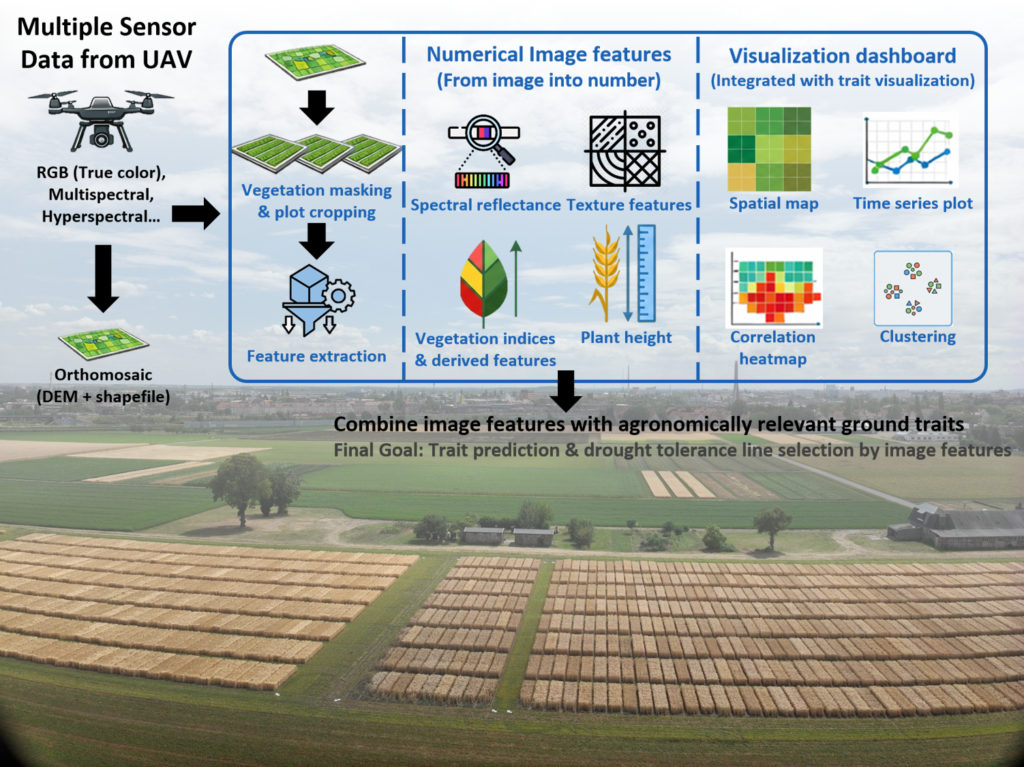





DiPredict is driving AI-supported wheat breeding in Saxony-Anhalt. From data point to variety: DiPredict combines drone sensor technology and artificial intelligence to make wheat more resilient to drought stress in a targeted manner.
Wheat is the most important crop in Saxony-Anhalt – and faces enormous challenges: In particular, increasing drought stress events require varieties with stable yields under more difficult conditions. To this end, DiPredict is developing a unique system of digital phenotyping, AI-supported modelling and targeted selection to fundamentally accelerate the breeding of climate-resilient wheat varieties.
At the heart of the project is a multidimensional Datacube in which sensor data from multi-temporal drone overflights, genome sequences as well as ground and weather data are fused. Various drone-based sensors (including multi-/hyperspectral cameras, LiDAR and thermal sensors) record a diverse set of wheat genotypes at numerous locations in Saxony-Anhalt, supplemented by experiments to model water use efficiency in the plantarray system at JKI Quedlinburg. With the help of machine learning and other AI methods, predictive models for genotype×environment interactions are developed, enabling breeding companies to select genotypes for variety development in a faster, more targeted manner. In addition, conclusions are drawn as to the conditions under which sensor technology can be used with maximum effectiveness in order to enable transfer to practical breeding.
DiPredict is funded by the European Regional Development Fund (ERDF).

Partners
Research partners
• Julius Kühn Institute, Institute for Resistance Research and Stress Tolerance, Quedlinburg
• Martin Luther University Halle-Wittenberg, Chair of Plant Breeding
• Martin Luther University Halle-Wittenberg, Institute of Computer Science• Anhalt University of
Applied Sciences, Digital Technologies in Plant Production Working Group, Köthen
Industry partner
• Compolytics GmbH, Barleben
• RAGT 2n S.A.S., Wernigerode
Plant DiTech’s innovative PlantArray system is used to record the weight, and thus the water consumption, of up to 120 wheat plants simultaneously over the course of the day at 3-minute intervals and under controlled conditions. This allows conclusions to be drawn about the water use efficiency of specific genotypes depending on different drought stress scenarios. Since the stress scenarios can be individually programmed and implemented automatically, the drought stress can be controlled in a targeted manner, which improves comparability with field conditions. The ultimate goal is to predict water use efficiency using multispectral data using statistical and machine learning models.
Contact:
Julius Kühn Institute (JKI) Quedlinburg
Institute for Resistance Research and Stress Tolerance
Dr. Andreas Stahl
andreas.stahl@julius-kuehn.de
Solmaz Khosravi
solmaz.khosravi@julius-kuehn.de
Dr. Gwendolin Wehner
gwendolin.wehner@julius-kuehn.de
Sebastian Warnemünde
sebastian.warnemuende@julius-kuehn.de

The identification of important agronomic traits is one of the core competencies in the development of new varieties in plant breeding. In order to objectify this task and make it high-throughput, image analysis methods will be developed to quantify the number of ears of wheat and the disease resistance of the wheat based on image data. In addition to classic RGB images, hyperspectral and LiDAR sensors are also to be used for this purpose. The models developed in this way will then be made available to wheat breeding.

The project aims to optimize the sensor-based evaluation of drought stress tolerance for wheat and make it high-throughput. Anhalt University of Applied Sciences is researching and developing Kl-based methods for the reliable sensor-based detection of drought stress under field conditions using a DLG test facility for underfloor irrigation at the Bernburg-Strenzfeld site. A special focus is on the use of drone- and aircraft-based hyperspectral sensors in different wavelength ranges to detect drought stress symptoms and the physiological reactions of crops.
Millions of data points are only valuable if they are intelligently linked. Compolytics develops algorithms that use multimodal data from special sensor technology to model agronomically relevant characteristics. The non-invasive methods thus make it possible to gain insights into the stress physiology of plants in order to be able to identify particularly resilient genotypes in a targeted manner. The models can be transferred to new genotypes or other crop species without complete retraining (transfer learning). This creates an AI infrastructure that can be used far beyond wheat cultivation.

You are currently viewing a placeholder content from Vimeo. To access the actual content, click the button below. Please note that doing so will share data with third-party providers.
More InformationYou are currently viewing a placeholder content from YouTube. To access the actual content, click the button below. Please note that doing so will share data with third-party providers.
More InformationYou need to load content from reCAPTCHA to submit the form. Please note that doing so will share data with third-party providers.
More Information